
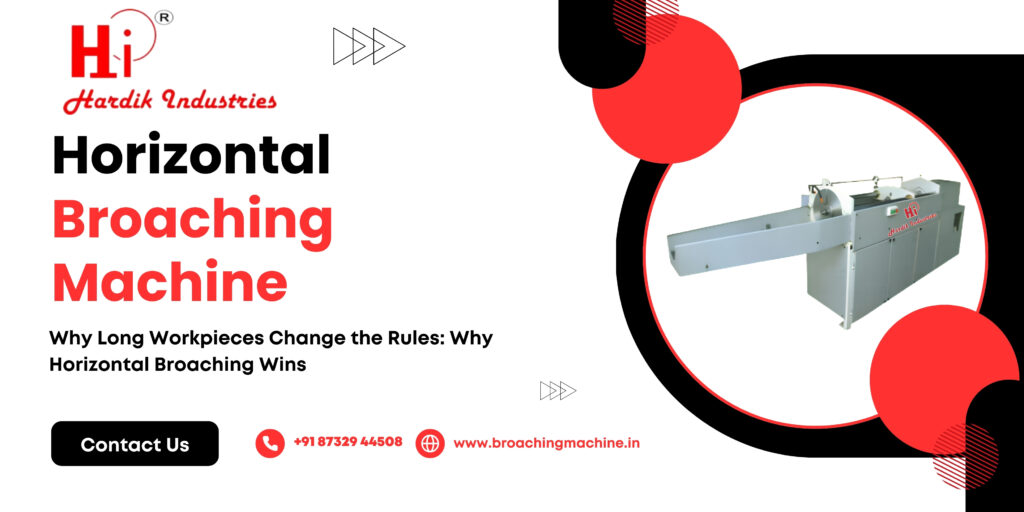
Why Long Workpieces Change the Rules: Why Horizontal Broaching Wins
In heavy engineering, automotive transmission manufacturing, and large gear production, component dimensions dictate the entire machining process. When production planners and manufacturing engineers are tasked with cutting internal keyways, heavy-duty splines, or complex multi-tooth profiles into massive, elongated parts, standard vertical setups often hit physical constraints.
For heavy-duty operations handling oversized elements, the Horizontal Broaching Machine remains the gold standard of precision engineering. But what makes a horizontal orientation fundamentally superior for long workpieces? Let’s break down the mechanical advantages, floor-shop logistics, and why structural stability matters in modern manufacturing.
The Engineering Challenge of Long Components
When you push or pull a heavy cutting tool through a deep workpiece, mechanical stability is everything. If a component is long, heavy, or irregularly shaped, several structural challenges arise during the machining cycle:
Gravity and Material Deflection: Vertical alignment puts immense lateral stress on both the tool and the workpiece. Under its own weight, a heavy part can shift slightly, ruining tight tolerances.
Clamping Complexity & Floor Clearance: Long shafts, heavy gear blanks, and industrial pulleys require stable, supported beds where the part can rest horizontally without requiring over-engineered, slow-loading clamping fixtures.
Chip Evacuation Bottlenecks: In deep internal cuts, metal chips generate rapidly. If gravity works against proper clearance, chips can pack tightly into the tool teeth, causing chatter marks, surface tearing, or catastrophic tool breakage.
Key Advantages of Horizontal Broaching for Oversized Parts
1. Unmatched Bed Rigidity and Support
The elongated, flat bed of a horizontal machine allows heavy workpieces to be securely mounted flat against the faceplate or resting on precision steady supports. This evenly distributes the weight of the component, eliminating the micro-vibrations and structural deflection common when mounting heavy parts vertically.
2. Superior Handling for Long Shafts and Gears
For components like long transmission shafts, marine drives, or large agricultural machinery pulleys, a horizontal layout allows the tool to glide smoothly along the horizontal axis. The part stays securely stationary while the broach travels the length of the bed, ensuring absolute concentricity and alignment from one end of the cut to the other.
3. Better Control Over Deep Internal Profiles
When cutting deep internal keyways or multiple heavy splines, a horizontal setup provides smoother stroke travel and better integration with continuous, high-pressure coolant delivery. The horizontal path naturally assists in flushing out metal chips away from the cutting zone, keeping operating temperatures low and tool life high.
Horizontal vs. Vertical: Knowing When to Switch
While vertical systems are phenomenal for high-speed batch production (especially when utilizing a Vertical Broaching Machine Pull Type or a Vertical Broaching Machine Push Type for compact parts), they are simply not built for oversized, heavy-length components.
If your facility is dealing with parts that exceed standard vertical ceiling clearances or require heavy horizontal bed support, switching to a dedicated horizontal configuration is essential to maintain production velocity and dimensional accuracy.
Conclusion: Engineering for Long-Term Production Reliability
Choosing the right machine configuration prevents costly downtime, reduces scrap rates, and preserves expensive cutting tools. If your facility specializes in heavy-duty components that demand absolute precision across long strokes, integrating a robust horizontal solution is critical for long-term industrial productivity.
To explore specifications built for heavy industrial workloads, view our range of robust Horizontal Broaching Machines.
Looking for custom solutions, tonnage calculations, or expert engineering advice on your next production setup? Contact Hardik Industries today.