
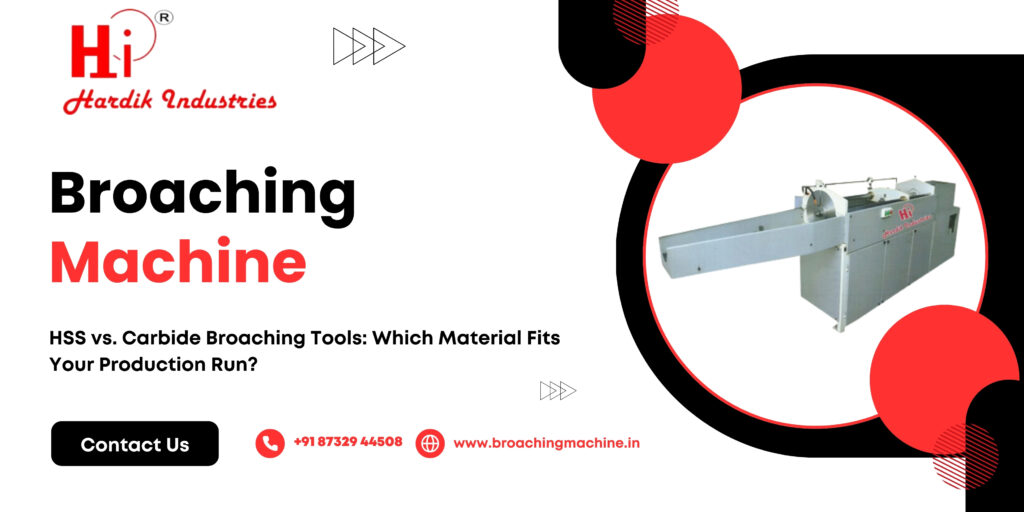
HSS vs. Carbide Broaching Tools: Which Material Fits Your Production Run?
In precision metalworking, the quality of the machine is only as good as the cutting tool performing the work. Whether you are running massive parts on a Horizontal Broaching Machine or executing high-volume batches on a Vertical Broaching Machine Pull Type, the choice of cutting tool material dictates your surface finish, tool longevity, and overall production economics.
When procurement teams and toolroom engineers specify new broaches for keyways, splines, or custom profiles, the debate almost always boils down to two heavyweights: High-Speed Steel (HSS) and Carbide.
Let’s break down the metallurgical differences, advantages, and ideal production scenarios for both materials.
High-Speed Steel (HSS): The Industry Workhorse
High-Speed Steel has been the backbone of broach manufacturing for decades. It is an alloyed steel containing tungsten, molybdenum, chromium, and vanadium, designed to maintain its hardness even under high frictional temperatures.
Key Advantages of HSS Broaching Tools:
High Toughness and Impact Resistance: HSS has superior shock absorption. If a workpiece has minor inclusions or uneven hardness spots, HSS flexes slightly rather than fracturing catastrophically.
Cost-Effective Initial Investment: For custom profiles, specialized splines, or low-to-medium volume runs, HSS tooling is significantly more affordable to manufacture and resharpen.
Easy Resharpening: HSS broaches can be easily re-ground multiple times in a local toolroom, extending the active lifecycle of the tool across thousands of parts.
Best Used For:
General-purpose engineering, softer alloy steels, cast iron, custom low-volume production runs, and operations where machine setup might experience occasional micro-vibrations.
Carbide: The High-Performance Specialist
Solid carbide or carbide-tipped broaching tools are engineered for extreme wear resistance and ultra-high-speed production environments. Carbide combines tungsten carbide particles with a cobalt binder, creating a material that is drastically harder and more rigid than HSS.
Key Advantages of Carbide Broaching Tools:
Extreme Wear Resistance: Carbide retains its razor-sharp cutting edge significantly longer than HSS, allowing for massive production runs without frequent tool changes.
Higher Cutting Speeds: Because carbide can withstand much higher thermal loads, you can push your machine feed rates faster, reducing overall cycle times.
Superior Performance on Hardened Materials: When broaching pre-hardened steels, abrasive superalloys, or exotic metals, carbide prevents rapid edge degradation.
Best Used For:
Massive, high-volume automotive runs (such as on Vertical Broaching Machine Push Type setups), abrasive materials, and automated production lines where minimizing downtime is worth the higher upfront tooling investment.
Key Factors to Guide Your Decision
When choosing between HSS and Carbide for your specific application, evaluate these three variables:
Production Volume: If you are running millions of identical parts, the longevity of carbide justifies its cost. If you are handling diverse, small-batch custom jobs, HSS offers better flexibility.
Workpiece Material Hardness: Softer structural steels and cast irons do not require the extreme hardness of carbide, making HSS the more economical choice. Hardened or abrasive alloys lean heavily toward carbide.
Rigidity of the Setup: Carbide is brittle. If your machine bed or clamping fixture has any play or vibration, a carbide tool can chip. Rigid, high-stability machines are mandatory for carbide tooling.
Maximizing Tool Lifecycle
Regardless of whether you choose HSS or carbide, proper maintenance—such as correct coolant concentration, routine cleaning, and timely resharpening—is essential to protect your tooling investment.
Need expert guidance on selecting the right broaching tool geometry or machine setup for your plant? Contact Hardik Industries today.