
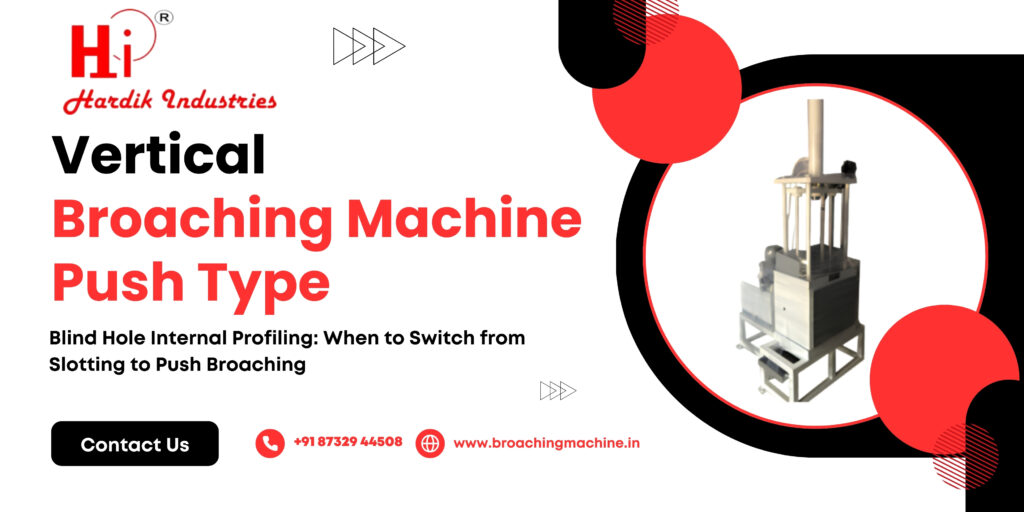
Blind Hole Internal Profiling: When to Switch from Slotting to Push Broaching
In precision machine shops, cutting internal features where the tool cannot exit out the bottom of the workpiece—commonly known as blind holes—presents a unique engineering challenge. Whether you are machining blind keyways, partial splines, or internal square profiles in gear blanks, the method you choose directly impacts your cycle times, tool wear, and bottom-line profitability.
For decades, many shops relied entirely on vertical slotting machines for blind hole applications. However, as production demands shift toward higher repeatability and better surface finishes, more manufacturers are transitioning to a dedicated Vertical Broaching Machine Push Type.
Let’s examine how push broaching compares to traditional slotting and when your plant should make the switch.
The Limitations of Traditional Slotting for Blind Bores
Traditional slotters use a single-point tool that scrapes away metal stroke-by-stroke until the desired depth or keyway width is reached. While versatile for custom, one-off job shops, slotting introduces distinct bottlenecks in a modern production environment:
Slow Metal Removal Rates: Because a slotter removes material using a single reciprocating point, it requires numerous passes. This drastically inflates cycle times per component.
Higher Tool Wear and Thermal Stress: Single-point scraping generates localized friction and heat, leading to rapid tool edge degradation and frequent manual adjustments.
Inconsistent Surface Finishes: Operator intervention and multi-pass chipping can leave micro-steps or rough textures along the floor of a blind keyway, often requiring secondary hand-filing or finishing.
How Vertical Push-Type Broaching Solves the Problem
In contrast, a push-type vertical machine uses a multi-tooth broach where each successive tooth is slightly higher than the previous one. As the ram pushes the tool down into the blind bore, every tooth takes a precisely measured, uniform bite of metal in a single stroke.
1. Dramatic Reduction in Cycle Times
Because multiple teeth cut simultaneously in one downward stroke, a push broach accomplishes in seconds what takes a slotting machine dozens of reciprocating passes to complete. This transforms batch production speeds.
2. Superior Dimensional Repeatability
Push broaching relies on the fixed geometry of the tool rather than incremental machine adjustments. Once the fixture is set, every part produced matches exact micro-tolerances, eliminating human error and drastically reducing scrap rates.
3. Clean Termination in Blind Pockets
While through-holes allow a tool to exit cleanly, push broaching is specifically engineered with built-in relief zones or stop mechanisms to ensure precise, clean-edged termination when cutting keyways or splines that must stop short of a shoulder in a blind bore.
Optimizing Your Short-Stroke and Blind Hole Operations
Selecting the right machine configuration depends heavily on your part geometry. While deep through-holes favor pull systems, short strokes, shallow depths, and blind internal profiles are ideally suited for compact, high-efficiency downward operations.
To explore rigid, high-performance systems designed for precise internal shaping, view our range of Vertical Broaching Machines (Push Type).
Looking to evaluate whether your current internal profiling process can be optimized for higher output? Contact Hardik Industries today.